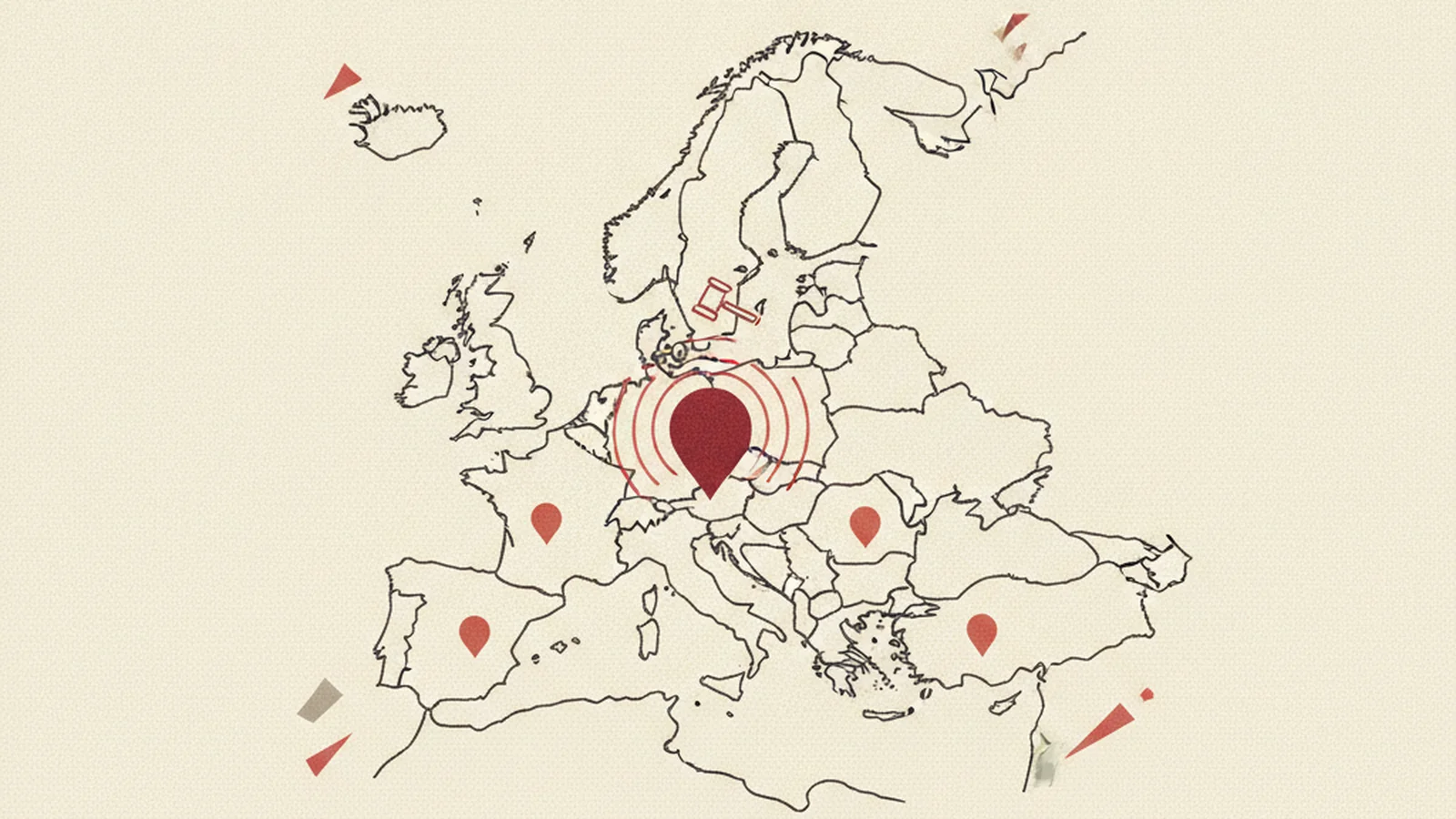
Talk to almost any compliance vendor about the European Accessibility Act and you will hear the same phrase over and over: "the EAA deadline." It gets said like there is one rulebook, one regulator, and one number that starts mattering the moment you cross it.
That is not what happened.
Since June 28, 2025, when the EAA's transposition deadline passed across the EU, member states have gone in genuinely different directions. Some have opened court cases. Some are letting private lawyers do the enforcing through warning letters, with no government agency involved at all. Some haven't touched a single company yet, publicly. And the fine amount, the number every headline leads with, turns out to be the least interesting part of the story if you are trying to work out where enforcement actually lands next.
The Stat: Hungary's national transposition of the European Accessibility Act sets the highest published penalty ceiling of any EU member state, with fines reaching EUR 1,260,000 per violation. (Source: EU member state EAA transposition laws)
Four Countries, Four Completely Different Playbooks
The European Accessibility Act (the full text is on EUR-Lex if you want the source law itself) is an EU directive, not an EU regulation. That distinction sounds like a legal technicality, but it is the whole reason this article exists. A directive sets a goal and a floor. It does not hand every member state the same enforcement toolkit. Each country wrote its own transposition law, chose its own penalty structure, and picked its own enforcement body, or in some cases, chose not to build a dedicated enforcement body at all and left it to existing consumer protection or civil courts.
That means "EAA enforcement" isn't one thing you can prepare for once. It's at least four different things, and if you sell into more than one EU market, you are potentially exposed to all of them at the same time.
France: The First Lawsuits Are Already Filed
France moved first, and it moved through the courts rather than through a regulator's inbox. The first EAA-related lawsuits were filed in France in November 2025, months after the compliance deadline had passed but well before most companies expected any real legal action to materialize. That timing matters. It tells you the French approach isn't a slow bureaucratic wind-up, it's active civil litigation, and the published fine ceiling of up to EUR 375,000 is only the number attached to the judgment at the end of a case that a plaintiff already decided was worth bringing.
If your company has any commercial presence in France, being unable to point to a documented remediation effort by the time a claim lands is a materially worse position than having started the work late.
Germany: No Government Raid, Just a Letter From a Lawyer
Germany's pattern looks nothing like France's, and that is exactly the point of this comparison. Rather than a government agency opening files, German enforcement is running largely through the Abmahnung, a private warning letter mechanism long used in German competition and consumer law, now being applied to accessibility. A competitor, a consumer association, or an individual can send a formal warning letter demanding a fix and often a cease-and-desist declaration, with the threat of court action and cost recovery if you ignore it.
There is no waiting for a regulator's enforcement sweep here. The trigger can be a single person browsing your site. Germany's official fine ceiling of up to EUR 100,000 is real, but for most businesses, the letter itself, and the legal costs and public exposure that come with ignoring one, is the more immediate risk than the fine ever gets a chance to be.
Ireland: The Fine Is Small. The Criminal Exposure Isn't.
Ireland is the outlier on this list, and it is easy to miss why if you only look at the euro figure. Ireland's published civil fine ceiling, up to EUR 60,000, is the lowest of the four countries in this comparison by a wide margin. Judged purely on the fine amount, Ireland would look like the least aggressive enforcement regime in the EU.
That reading misses the actual exposure. Ireland's transposition law carries a criminal sanction alongside the civil fine, with imprisonment of up to 18 months possible on top of, not instead of, the financial penalty. A EUR 60,000 fine and a criminal conviction are not the same category of consequence for a director or officer of a non-compliant business. This is precisely why ranking countries by fine size alone is the wrong way to assess risk: the mechanism behind the number changes what you are actually risking.
Hungary: The Ceiling Every Headline Quotes
Hungary is the number that gets repeated the most, and for good reason: at up to EUR 1,260,000 per violation, it is the highest published penalty ceiling of any EU member state under national EAA transposition law. It is the figure that makes for an attention-grabbing headline, and it deserves the attention.
But treat it as a ceiling, not a forecast. A high published maximum tells you what a worst-case, most-severe, most-repeated violation could theoretically cost in Hungary. It does not, on its own, tell you how aggressively Hungarian authorities are pursuing cases, how quickly, or against which kinds of companies. The size of the number is real. What it predicts about your own near-term exposure is a separate question, and one this whole comparison is built to get you asking.
What This Means If You Sell Into Multiple EU Countries
If your business ships to customers in more than one of these four countries, and most EU-facing ecommerce and SaaS businesses do, you are not choosing which enforcement regime applies to you. You are subject to all of them, simultaneously, in whichever country your customer happens to be sitting in when they hit a barrier on your site.
A few practical takeaways follow directly from that:
- Don't calibrate urgency off Hungary's fine ceiling alone. It is the biggest number, but France is the country where lawsuits are already a matter of public record, and that is arguably the more urgent signal for how fast this can move.
- Take German warning letters seriously the first time, not the third time. The Abmahnung system is designed to escalate quickly and cheaply for the sender. A fast, documented fix in response to a first letter is far cheaper than fighting one in court.
- If you have officers or directors based in or traveling to Ireland, treat the criminal exposure as a governance question, not just a finance one. That is a board-level risk conversation, not a line item.
- Document your remediation work as you go, everywhere. Every one of these four enforcement paths rewards a company that can show an honest, ongoing effort, and penalizes one that can only point to a policy page written after the fact.
If you have not yet worked through what the EAA requires of your business in the first place, our EAA compliance guide for US companies selling into Europe and our breakdown of who actually has to comply and since when are the right starting points before you dig into country-specific enforcement mechanics. If you want a working list to run against your own site right now, our eight-point EAA checklist for EU-facing sites is built for exactly that. We also covered the broader shift from warning shot to active enforcement in EAA enforcement in 2026 for US companies, and if your store runs on Shopify or WooCommerce specifically, our platform-specific fix list walks through the most common gaps we see on those stacks.
The European Commission also maintains an official overview of accessibility policy and the EAA rollout if you want to track official guidance directly from the source rather than through a summary like this one.
None of this requires you to become an expert in French civil procedure or German competition law to get ahead of it. It does require an honest, current picture of where your site actually stands against WCAG, and a remediation plan that can hold up if a letter or a claim shows up in any of these four countries, or the next one to start moving. That is the exact gap our team at WCAG.World closes for EU-facing businesses through our EAA compliance program.
If you want a second set of eyes on where your business actually stands across these enforcement regimes, reach a real person on our team at experts@wcag.world, or start with our EAA compliance solutions page to see how we can help.